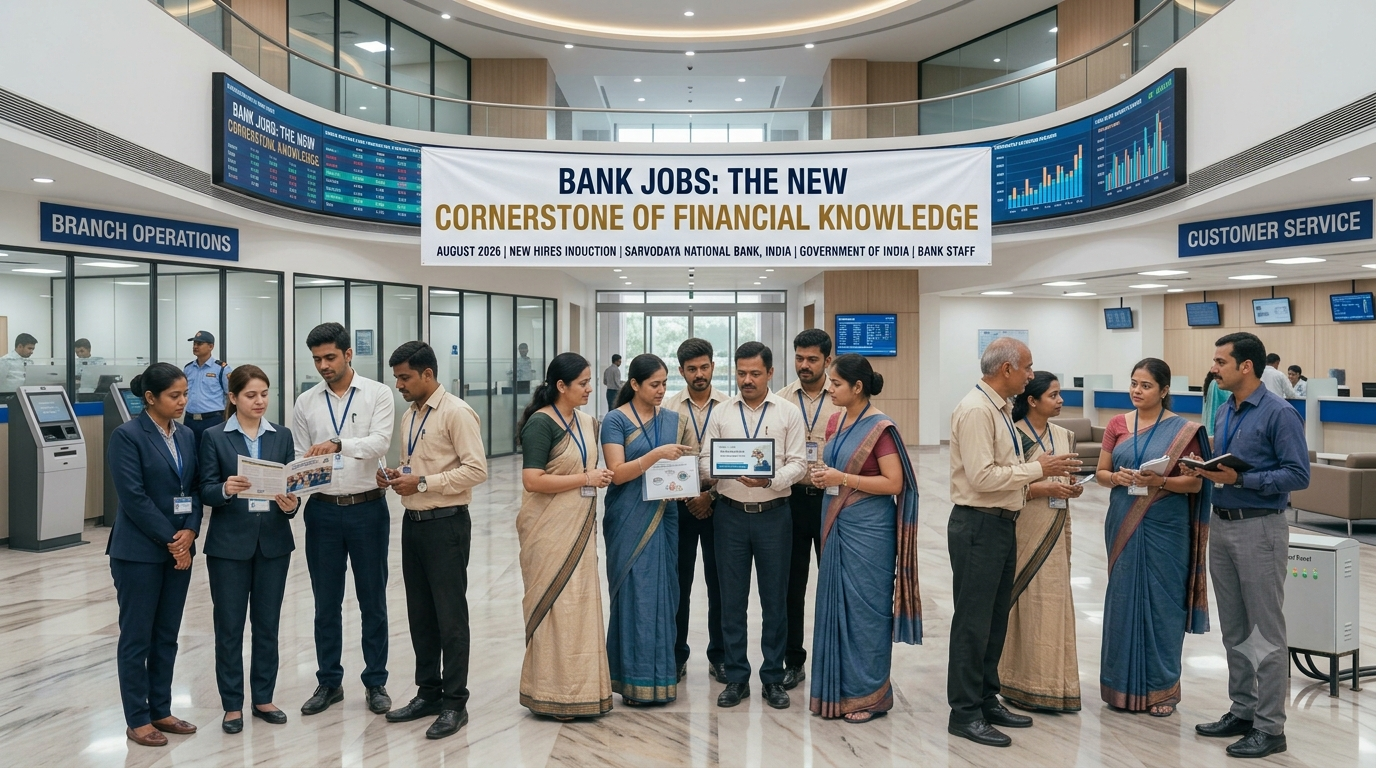
The banking sector in 2026 is witnessing a transformative recruitment phase, with prestigious public sector banks and private institutions actively seeking postgraduate candidates for high-value positions.
The Union Bank of India has announced 395 Officer vacancies with salaries reaching up to ₹47 lakh per annum, while IBPS has released 6,715 Probationary Officer positions, and Bank of India is recruiting 779 Credit Officers in the General Banking Officer stream. For postgraduate degree holders, specialized certifications, and experienced professionals, bank jobs offer an exceptional combination of compensation, career growth, and job security. This comprehensive guide explores the premium landscape of banking careers for post graduates, covering eligibility criteria, salary structures, application procedures, and strategies to secure the most coveted positions.
Why Post Graduates Should Target Bank Jobs
Access to Premium Salary Scales
Bank jobs for post graduates open doors to significantly higher compensation compared to general graduate recruitment. Union Bank of India’s recent recruitment for Officer positions offers annual compensation ranging from ₹21 lakh for Manager (MMGS-II) to an impressive ₹47 lakh for Deputy General Manager (TEGS-VI) positions . These figures reflect the premium placed on advanced qualifications and specialist expertise in the current banking sector.
Fast-Track Career Progression
Postgraduate qualification often serves as a catalyst for accelerated career growth in the banking sector. Institutions like the State Bank of India actively recruit professionals through lateral entry and Specialist Officer positions across domains including data centres, information technology, risk management, legal, treasury, compliance, and data analytics . These positions recognize the value of specialized postgraduate education and offer defined career advancement tracks.
Professional Development Opportunities
Private banks and financial institutions offer structured management programs specifically designed for postgraduate degree holders. The Axis Bank recruitment drive for over 8,500 positions accepts postgraduate candidates, with roles spanning branch manager, executive officer, assistant manager, and cluster head positions . The sector’s forecasted 8.7% growth in BFSI headcount for FY 2025-26 indicates sustained demand for qualified professionals .
Types of Bank Jobs for Post Graduates
Public Sector Bank Officer Positions
Public sector bank jobs remain among the most prestigious opportunities for post graduates. Major recruitment drives include:
Specialist Officer Positions
For post graduates with specialized qualifications, Specialist Officer positions offer excellent career paths:
Private Sector Banking Roles
Private banks offer dynamic career opportunities for post graduates with strong compensation packages:
- Corporate Banking Relationship Manager: Managing business client relationships, credit facilities, trade finance, and cash management. Entry level ₹7-10 LPA, mid-level ₹12-18 LPA
- Investment Banking Analyst: Advising on capital raises, mergers, acquisitions, and IPOs. Starting salaries ₹12-25 LPA with high growth potential
- FinTech Product Manager: Digital lending operations, payment infrastructure, product management. Entry level ₹10-16 LPA
- Wealth Manager: Financial planning, investment advisory for HNI clients. Entry level ₹8-12 LPA
Regulatory and Research Positions
Post graduates with strong academic backgrounds can target elite positions:
- RBI Grade B Officer: Requires 60% in graduation (55% for postgraduates), age 21-30 years. Selection through Phase I, Phase II, and Interview
- NABARD Grade A Officer: Focus on rural development, agriculture, economics. Requires graduation with 60% marks
- RBI Young Professional: Contractual positions for postgraduates. 12 vacancies announced with ₹1.5 lakh monthly salary
Specialized Bank Courses for Post Graduates
PGDM in Banking and Financial Services
The Post Graduate Diploma in Management (PGDM) with specialization in Banking, Insurance, and Financial Services offers the highest ROI path for post graduate banking careers. According to industry reports, graduates from accredited BFSI programs consistently enter at ₹10-18 LPA at leading private banks, NBFCs, and financial institutions . The two-year curriculum covers credit markets, investment banking, treasury, insurance regulation, and financial services strategy, building both technical depth and management capability .
Professional Certifications for Banking Careers
| Certification | Best Suited For | Starting Salary Range | Duration |
|---|---|---|---|
| CFA (Chartered Financial Analyst) | Investment research, asset management | ₹8-15 LPA (Level 1-2) | 2-4 years |
| FRM (Financial Risk Management) | Risk management, credit analysis | ₹8-12 LPA | 1-2 years |
| CFP (Certified Financial Planner) | Wealth management | ₹7-12 LPA | 6-12 months |
| NISM Certifications | Capital markets, MF distribution | ₹4-7 LPA | 1-3 months each |
For post graduates, combining a PGDM with certifications like CFA or FRM creates the strongest career foundation. As industry experts note, “Certifications are valuable. They’re most valuable when they sit on top of a management foundation, not instead of one” .
Bank Jobs Salary Structure for Post Graduates
Public Sector Bank Officer Salary Matrix
Private Sector Banking Salary Trends
| Role | Entry Level | Mid-Level (3-5 Yrs) | Senior Level |
|---|---|---|---|
| Corporate Banking RM | ₹7-10 LPA | ₹12-18 LPA | ₹22-35 LPA |
| Credit/Risk Analyst | ₹8-12 LPA | ₹15-22 LPA | ₹25-40 LPA |
| Investment Banking Analyst | ₹12-25 LPA | ₹22-35 LPA | ₹40 LPA+ |
| Wealth Manager | ₹8-12 LPA | ₹15-22 LPA | ₹28-45 LPA |
| FinTech Product Manager | ₹10-16 LPA | ₹18-28 LPA | ₹35-55 LPA |
How to Apply for Bank Jobs
Application Process & Official Verification
The application process for bank jobs has been completely digitized to ensure absolute operational transparency and rapid departmental onboarding. Candidates must strictly ensure they possess all required educational certificates, highly localized identity proofs, and highly active digital communication channels before initiating the process. You must always rigorously verify active recruitment notifications by directly accessing official .gov.in or .ac.in domains such as ibps.in, sbi.co.in, or unionbankofindia.bank.in to ensure authentic E-E-A-T signals.
Step-by-Step Application Process
Step 1: Visit the Official Portal
Go to the official recruitment website of the respective bank or IBPS.
Step 2: Complete Registration
Register using a valid email ID and mobile number to generate login credentials.
Step 3: Fill the Application Form
Carefully enter personal, educational, and experience details as required. For Union Bank of India recruitment, applications are open from July 21 to August 10, 2026 . For IBPS PO, registration runs from July 1 to July 21, 2026 .
Step 4: Upload Required Documents
Upload scanned copies of photograph, signature, educational certificates, and category certificates (if applicable).
Step 5: Pay Application Fee
Step 6: Submit and Download
Double-check all information, submit the application, and download the confirmation page for future reference.
Candidates can also strategically explore equivalent verified opportunities through reputable private job portals such as Naukri, Indeed, and LinkedIn, though primary applications must be submitted on the official government websites.
Frequently Asked Questions
1. Which banking exams can post graduates apply for?
Post graduates can apply for virtually all banking exams including IBPS PO, SBI PO, RBI Grade B, NABARD Grade A, and various Specialist Officer recruitment drives. SBI PO and IBPS PO are open to graduates from any discipline, while RBI Grade B requires 60% marks in graduation .
2. What is the salary for Union Bank Officer positions?
Union Bank Officer positions offer annual compensation ranging from ₹21 lakh for Manager (MMGS-II) to ₹47 lakh for Deputy General Manager (TEGS-VI). In addition, employees receive Special Allowance, Dearness Allowance, residential quarters or lease rent, LFC, and medical reimbursement .
3. What qualifications are required for Credit Officer positions in Bank of India?
Bank of India Credit Officer positions require graduation with 60% (55% for SC/ST/OBC/PwBD) or CA/CMA-ICWA/CS/CFA qualifications. For MMGS-II, 3 years of officer experience with 2 years in credit-related roles is required. Higher scales require proportionately more experience .
4. Can final-year post graduate students apply for banking exams?
Final-year students may apply for some banking exams like SBI PO on a provisional basis, but must submit proof of graduation by the date mentioned in the official notification .
5. What is the application fee for IBPS PO 2026?
The application fee for IBPS PO 2026 is ₹850 for General/OBC/EWS candidates and ₹175 for SC/ST/PwBD candidates .
6. How many vacancies are available in IBPS PO 2026?
IBPS has announced 6,715 Probationary Officer and Management Trainee vacancies across various Public Sector Banks for 2026 .
7. What is the selection process for Union Bank Officer positions?
The selection process for posts up to Scale III may comprise an online examination, group discussion, and personal interview. Postings in Scale IV to VI may involve group discussion, other assessments, and a personal interview, depending on the number of applicants .
8. What are the best banking courses after post graduation for high-paying jobs?
For management-track roles, a PGDM in Banking and Financial Services offers the highest ROI with entry salaries of ₹10-18 LPA. For investment roles, CFA is the gold standard. For risk management, FRM is most relevant. For government banking, IBPS/SBI PO exam preparation is the direct route .
9. Are there any age relaxations for reserved categories in banking exams?
Age relaxation varies by exam. For Union Bank, SC/ST candidates get 5 years, OBC-NCL get 3 years, PwBD get 10 years relaxation . Similar relaxations apply for other public sector bank recruitments.
10. What are the Specialist Officer (SO) positions in banking?
Specialist Officer positions are technical roles requiring specific qualifications and experience. Union Bank’s recruitment includes IT specialists in cybersecurity, cloud administration, data analytics, blockchain, API management, as well as Chartered Accountants, legal officers, architects, engineers, and risk management professionals .
Conclusion
Bank jobs for post graduates in 2026 represent a golden opportunity for career advancement, offering premium compensation packages, accelerated growth trajectories, and diverse professional pathways. From the prestigious 6,715 IBPS PO positions to the high-value 395 Union Bank Officer vacancies with salaries reaching ₹47 lakh per annum, the banking sector is actively recruiting talented post graduates across multiple specializations .
Whether you aspire to join the public sector through competitive examinations, pursue a specialist career in private banking with professional certifications, or build management credentials through a PGDM in Banking and Financial Services, the sector offers clear pathways for career progression. The estimated 8.7% growth in BFSI headcount for FY 2025-26 indicates sustained demand for qualified banking professionals .
To secure premium banking careers, post graduates should align their qualifications with specific sector needs. For management-track roles at leading private banks, a PGDM in banking combined with relevant internships provides the strongest foundation . For public sector banking, rigorous preparation for competitive exams is essential. For specialist roles, professional certifications like CFA, FRM, or specialized degrees such as CA/CMA/CS are crucial .
The recruitment landscape for bank jobs continues to evolve with digitization, making the application process more transparent and accessible. By following the guidelines outlined in this comprehensive guide, aspiring post graduates can navigate the application process successfully and secure rewarding employment opportunities in India’s dynamic banking sector.
Disclaimer: This article is for informational purposes only. The application process is free of cost; beware of fraudulent recruiters. Always verify job postings through official channels and never share personal financial information with unauthorized parties.